
The Business Value of Science Based Targets: From Compliance to Competitive Advantage

30 Jun 2026
In the race toward net zero, many organizations are asking a critical question: Is setting a Science Based Target (SBT) truly worth it? If you do set one, does the ongoing commitment to reduce your greenhouse gas (GHG) emissions become a burden? And what if you don’t? Could your business become less competitive as SBT become the norm among your customers and your competitors?
Recently, I read a 2025 study published in The British Accounting Review on how adopting SBTs influence corporate decarbonization, performance trends post Paris Agreement, and financial outcomes. The study offers a compelling answer – many of the world’s largest companies that embrace SBTs are not just reducing emissions, they are building stronger, more resilient businesses.
The study highlights several key insights:
- Measurable emissions reductions: Companies with SBTs achieve significant declines in both absolute emissions and emissions intensity.
- Acceleration after the Paris Agreement: Those with SBTs show a faster and more consistent downward emissions trajectory in the years following 2015.
- No profitability penalty: Perhaps most importantly, the data finds no negative impact on financial performance, dispelling a long held concern that sustainability comes at the expense of profit.
- Stronger results in supportive environments: SBTs are even more effective in jurisdictions with robust regulatory frameworks, emissions trading schemes, or among companies with strong ESG performance.
While much of the analysis focuses on large corporations, the implications extend to small and medium sized enterprises (SMEs) as well. Collective progress toward global climate goals hinges on participation across the entire value chain.
A Real World Case Study
A multinational consumer goods company turned ambitious SBTs, spanning Scope 1, 2, and 3 reductions and net zero by 2039, into a strategic advantage by embedding them into core operations. As a result, they are less exposed to fossil fuel volatility, improved energy efficiency, reduced long‑term costs, and stronger growth driven by innovation, circular packaging, and sustainable sourcing, supported by sharper Scope 3 insights from over 250 supplier‑specific carbon footprints.
Just as importantly, the company strengthened investor confidence, built trust with stakeholders, reduced greenwashing risk, and became more attractive to top talent.
It is apparent that SBTs don’t hold businesses back. Instead, they unlock performance, sharpen resilience, and accelerate transformation.
Reviewing Drivers and Barriers for your Organization
Of course, adopting an SBT is not without challenges. Organizations must consider both the opportunities and trade offs involved. If you were to do a quick brainstorm exercise:
- Which of the following benefits and costs would you consider relevant to your organization?
- Could engaging external expertise and leveraging established procedures significantly lower barriers and accelerate progress?
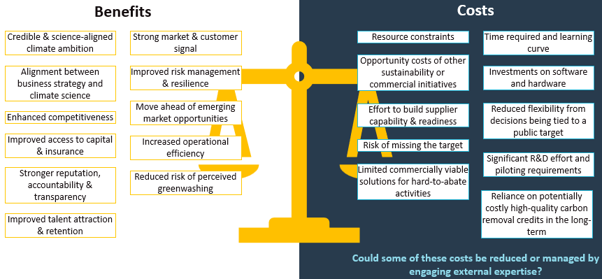
Ultimately, the real question is not whether an organization can set an SBT, but whether it can afford not to. If it is treated solely as a compliance obligation, SBTs risk becoming a box ticking exercise. But when positioned as a strategic lever, they can become a catalyst for transformation, driving efficiency, innovation, resilience, and competitiveness.
In an increasingly volatile, climate constrained world, the companies that thrive will be those that align their business models with the realities of a low carbon future.
