Setting Ambitious yet Feasible Decarbonization Strategies

07 Jul 2026
For many organizations, one of the most challenging aspects of developing a decarbonization strategy is not defining the ambition (i.e., the “target”), but determining how to achieve it.
This requires a careful balance of realism and creativity. It involves forecasting future emissions, understanding today’s operational constraints, identifying practical opportunities, and investing in solutions that may still be evolving.
Having a Clear and Plausible View of the Future
An often overlooked but foundational step is forecasting future emissions.
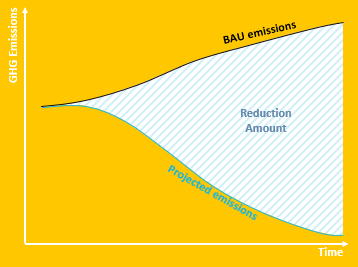
After setting a long-term target, companies often calculate the required reductions by comparing target-year emissions with the base year emissions. However, this is incorrect. Instead, companies should be comparing against business-as-usual (BAU) emissions, which is the emissions trajectory assuming no additional reduction initiatives as the business grows.
In other words, instead of a static comparison against the base year emissions, which is a point in time “ceiling” from which the company’s greenhouse gas (GHG) performance is measured against, it should be a dynamic, year-on-year assessment of future emissions against the target pathway. In doing so, organizations gain a more realistic understanding of the scale of transformation required.
Embracing the “Gap”, Don’t Fear It
When viewed against BAU projections, the “gap” to target often appears significantly larger – and at times, overwhelming. Net-zero targets can further amplify this perception.
But this is not necessarily a bad thing. In fact, it can be a powerful catalyst for action. Rather than having an “achieve everything now” mindset, which can be paralyzing, it encourages an “act now” mentality grounded in urgency and progress.
While some initiatives offer quick wins, such as energy efficiency improvements or behavioral changes, other initiatives require longer time horizons and deeper systemic transformation. For example, electrifying heavy fleets, deploying carbon capture and storage (CCS), or developing hydrogen-based solutions. In some cases, viable technologies may not yet exist at the required scale or cost.
This is precisely where forward planning and sustained investment in innovation become essential.
Grounding Ambition in Reality
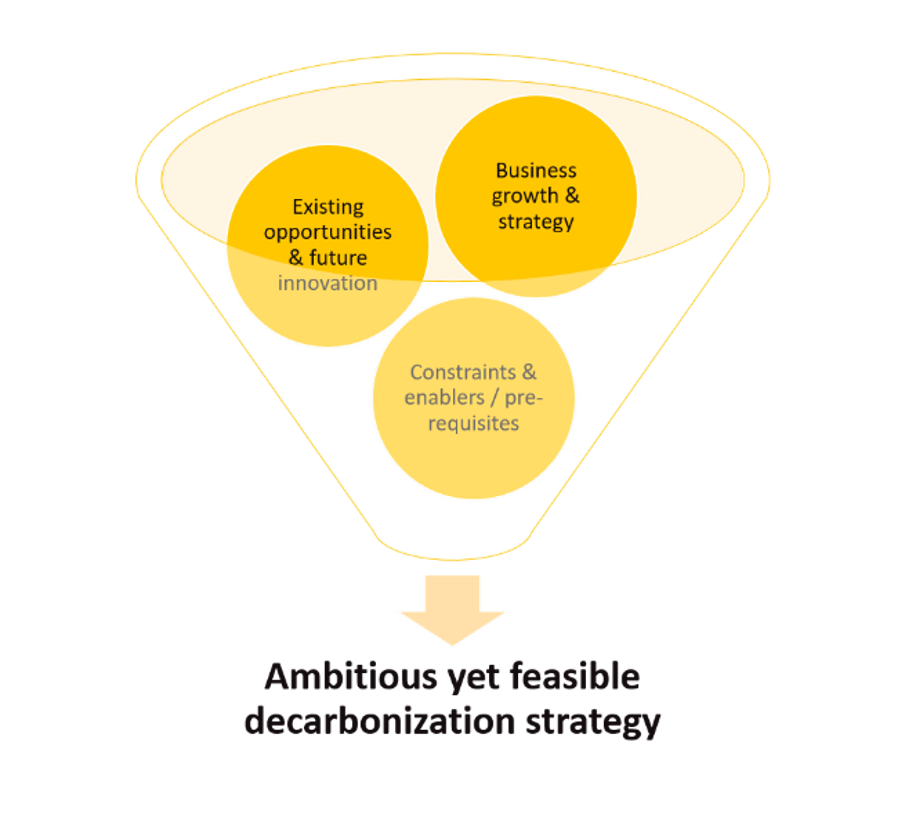
There are obviously more to consider, like understanding site constraints. But that’s precisely how decarbonization strategies gain credibility – by combining what’s possible now with longer term plans to embed emerging decarbonization technologies.
There will always be elements that are beyond a company’s direct control and that’s normal. However, companies are not powerless to influence change. They can foster partnerships across the value chain, support innovation and pilot projects, influence suppliers and customers, and invest in solutions that may not deliver immediate reductions but are essential for long term transformation.
Be honest with what your company can or cannot do now. This openness could open doors to constructive dialogues with external stakeholders.
Let Transparency Strengthen Your Strategy
Strong disclosure brings all these elements together, keeping in mind that good disclosure allows the thoughtfulness behind the process to shine through. Stakeholders will appreciate:
- An ambitious target that aligns with climate science;
- Projections grounded in robust and plausible scenarios; and
- Transparency about current capabilities and what it needs to do soon to give the company a better chance of achieving its target in the long term.
Act now to secure future decarbonization achievements!